
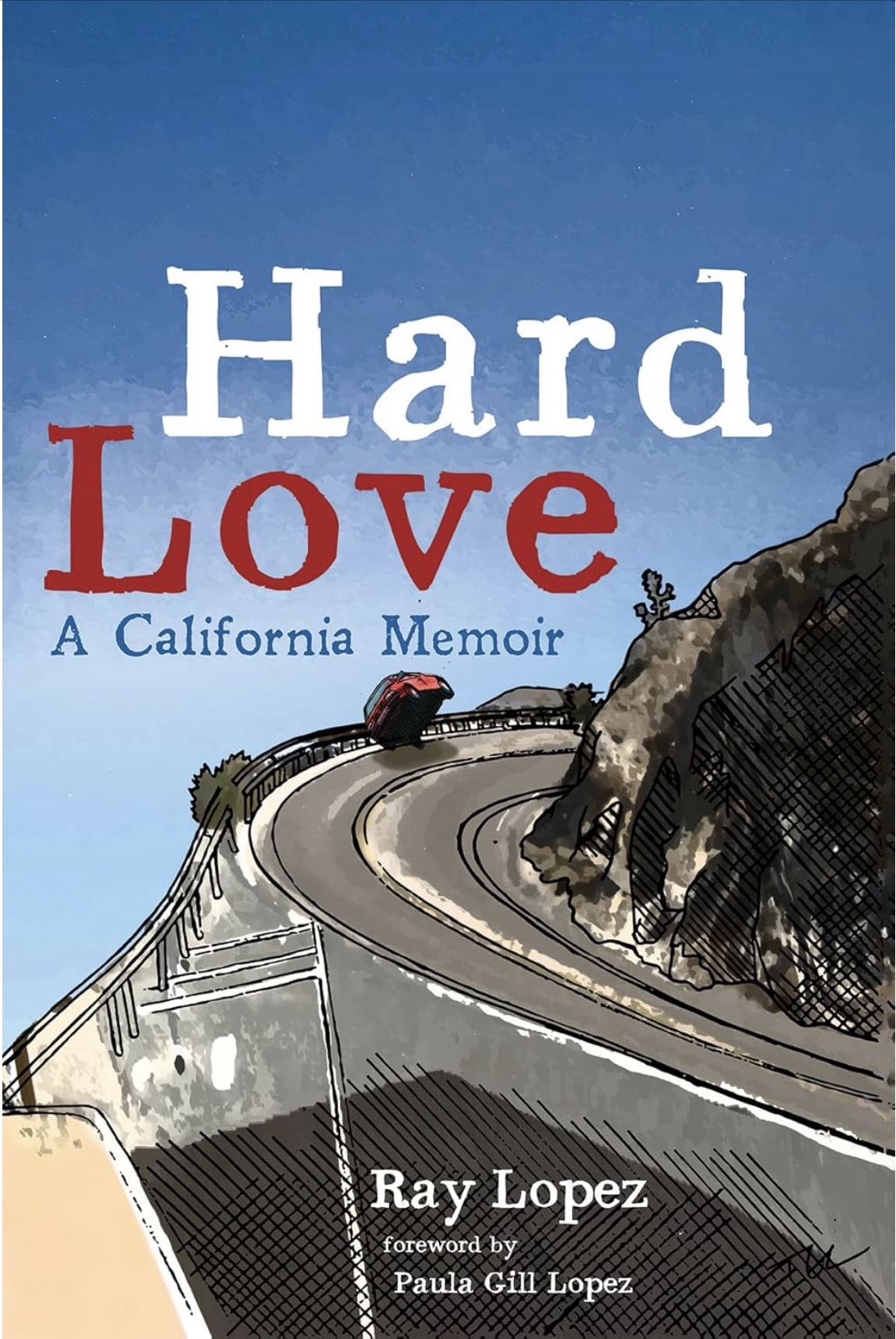
Hard Love
A California Memoir
“I do not understand what I do. For what I want to do I do not do, but what I hate I do.”
—Romans 7:15 (NIV)
“I should have been a pair of ragged claws. Scuttling across the floors of silent seas.”
—T.S. Elliot, The Love Song of J. Alfred Prufroc
Chapter 4
THE WEDDING
And so it Goes . . . the Great Lopez California Migration continues. My brother Steve flies out in August 1981 and stays with us for a month until his first wife, Bobbie, arrives in September after driving cross-country. It’s a very romantic story. Our families have been close friends since we were kids. Mom and Barbara (Bobbie’s mom) met when they worked together on the Commack Volunteer Ambu- lance Corp. Bobbie has a younger sister, Lori, and a younger brother, Chuck. The three are separated by a few years. We used to hang out all the time at each other’s homes. Bobbie and Lori have always loved Steve and would spend the entire time chasing him around the house. Bobbie and Steve move into a one-room apartment at Calle las Bollas, in an old Spanish-style building near the beach a few blocks away. The sink is in the middle of the living room. The other residents are mostly Marines, which worries me a bit.
After a couple of months, they move into the four-unit build- ing at 1002 Buena Vista. We live in apartment A, and they are in D on the upper level. Bobbie and Steve both get jobs at McDon- ald’s in San Clemente. She is quickly promoted to assistant man- ager and supervises Steve for three months, which inspires him to seek employment elsewhere. He gets a job on the maintenance/landscaping crew at the Dana Point Marina, where he works for about a year before finding his first engineering job. Bobbie leaves McDonald’s and works as a special education teaching assistant in the San Clemente school system. Our next-door neighbor from Commack, Vinny St. Pierre, moves to San Clemente in ’82. Bobbie and Steve eventually get married on the bluff overlooking the Dana Point Marina on July 24, 1982. Afterward, the reception is held at a house where Vinny is living, overlooking a canyon. I carry in the keg. Uncle George moves from New York City to L.A. in December 1983. We all followed my sister Teresa and our friends, Denise and Mark, who caravanned cross-country in June of ’y9. We all live in San Clemente but for Denise and Mark, who live in Dana Point in a trailer park just up the coast.
And we’re doing it. Paula is industrious. That first year, she starts attending Saddleback Community College in Mission Viejo while working two jobs. She waitresses at Howard Johnson’s in San Clemente, then the Jolly Roger at Dana Point Harbor. She finds her “peeps” teaching three-year-olds at an affiuent preschool in Laguna Niguel. She tutors kids for a woman who runs a home-based special education program. She does the bills, cooks the food, does the laundry, cleans the apartment, and makes breakfast, lunch, and dinner. I think we’re free, living with the ocean breeze, and don’t see that Paula is really sad and disconnected. Estranged from her mother, she self medicates with weed and alcohol, and I’m blind to the burden of the traditional role upon her life.
She’s also my training partner at the gym, and we make love at least twice a day, sometimes in exciting places like the beach. This inspires me to write . . .
T.V. Moonlight
Cool silver
T.V. moonlight loves you
on the soft old couch.
Your flesh glows like
a
fresh
snow
slope.
My tongue
skis
down.
from areola
into
the light brown forest.
We get drunk together and smoke a little weed with Larry, our good neighbor and friend from across the street.
He is a surfer dude, a skilled carpenter from Huntington Beach. He is a sportsman. He surfs, skis, dives for lobsters at night, goes spearfishing in the ocean for tuna, and goes four-wheeling in the desert in his Toyota truck. He also lifts at the San Clemente Health Club. He’s about 5’ 10,” weighs around 200 pounds, and has bushy blond hair and a thick mustache. He’s barrel-chested and benches 325. He’s the embodiment of the Southern California man. One winter day he starts out surfing at sunrise, goes four-wheeling in the desert on his way to Big Bear Lake, snow skis at Big Bear, and makes it back to end his day as it began— surfing— this time at sunset. California is amazing. We call him “Larry Larry,” a name initiated by Uncle George who very much appreciated Larry.
We have our own little beach community on Buena Vista. We look out for each other, party together, and help each other out. Sometime in ’82, Paula and I buy our new Toyota Tercel, a standard five-speed. Larry Larry is also a car guy who can do anything, like rebuild an engine. I know little to nothing. I want to change the oil one day, and Larry and Steve volunteer to oversee the project from a distance. They park themselves outside apartment D with a 12-pack of Michelob and give me the thumbs up. I get under the car, place the oil pan under the tank, unscrew the lid and drain it. It looks a little too clear to me, but I get the thumbs up from my supervisors when I question the viscosity. I finish the job and feel satisfied. That night driving to a poetry reading in Mission Viejo, the car sounds like a jet engine when I shift into fifth gear. It turns out that I drained the transmission fluid and added four quarts of oil. What’s the cost of naïve ambition? What’s the cost of a rebuilt transmission?
Paula is the kindest, smartest, most beautiful person I know. She’s amazing. I’m madly in love with her and want to get married, badly. My romantic warrior spirit has not yet fully matured, and so one day while soaking in some affectionate bliss, I say, “Hey, why don’t we get married?” and she says, “We can’t get married! We’re not even engaged.” So we get engaged. I spend a whopping $60 on a ring with a diamond chip. Our wedding doesn’t cost much more.
We decide to offer our marriage as a gift to the Lord, marrying on the beach in San Clemente on December 25, 1981. I would not recommend this date for those newly engaged as the memory and celebration of your anniversary gets lost in the season. We write our own vows. I come up with a rhyme scheme and somehow get in a reference to the zoo and our favorite animals. In addition to her vows, Paula also writes a short sermon on love to be read by the pastor. She is taking a philosophy course at the time. She writes about the power of love and starts talking about “Victor Frankel, a man who was forced to live in Nazi concentration camps as a child, forced to march in the snow from one camp to another; this is a man who could talk of love. . .” I convince her that her vows would have some of our guests suffering and wondering about her sanity, and we do a little editing. Paula designs the invitations, which say: “I can only find freedom in the ropes that bind me to you.” I wonder if people are going to think we might be into a little bondage. My parents don’t come because Paula’s parents won’t be there. She’s been disowned by her mother, Gloria, who’s still not talking to her. A week before the wedding, she calls Paula and tells her that if she marries on Christmas, she will ruin that day for the rest of Gloria’s life. I don’t really think much about this, about the pain and anguish in Paula’s heart. I just think about us. I just want to get married.
Our guest list includes: Teresa and Brad; Bobbie and Steve; Larry Larry; Mack, my supervisor from Los Pinos, with his wife and daughter; Phil, a counselor from the camp, with Chris, one of the youthful wards of the state; Tommy, a beach bum from San Cle- mente just released from Los Pinos; Bruce, another counselor; and Mark and Denise, who know an ordained minister who works full- time as a rodeo clown. I get ready at our apartment in the company of Steve, Mark, and Tommy. Meanwhile, Paula is with my sister at her place.
I’m wearing a white shirt with white slacks from a local con- signment shop on Del Mar. Paula finds the perfect wedding “gown” at the Santa Ana Flea Market for $13. Our wedding site is on the beach about halfway between 204 and the pier. We pick low tide because there are large rocks near the shore that Paula and I love to wade out to. The men and I head off to the wedding, down the stairs to the beach and toward the pier. We’re walking, four men, side-by-side, Steve on my right, Mark on my left, and Tommy next to Mark. We’re marching in the sand, stride-by-stride, when Steve starts whistling the tune from one of our favorite movies, The Good, The Bad, and The Ugly, and Mark declares that we are “the good, the bad, and the married.”
We arrive at the spot. Our guests are arriving. There’s a park- ing lot right there and a bluff on either side. For some reason un- known, Brad drops Paula off at the top of the bluff, and she has to scale down the steep hill. I see her up above, standing straight and tall, her golden hair artfully braided in a Baby’s Breath wreath. She descends, gracefully, carefully placing each step. Still, I’m afraid she might lose her footing and fall. She makes it unscathed yet a little out of breath. She looks like a medieval princess bride. Our guests surround us, and the rodeo clown starts the ceremony. There are joggers running and families walking by, pausing to see the wed- ding on Christmas Day on the beach. We exchange vows and sing a duet, “With You I’m Born Again” by Billy Preston and Syreeta. “Come show me your kindness. In your arms I know I’ll find this. . . I was half not whole, in step with none, reaching through this world in need of one. . .”
We are pronounced husband and wife and turn to walk into the ocean. But I’m stuck for a moment; I look down to see that my feet are buried in the sand up to my ankles. We stand on the rocks and watch the waves. The reception is on the patio at our apart- ment. We have wine and beer and our guests bring food. Paula cooks her first turkey in the oven in a brown paper bag, but in the imbibing we forget about it and find it the next morning still in the paper bag, still in the oven. Bobbie and Steve bring the cake, and I end up wearing most of it on my face when we cut the first slice for Paula to serve. We dance and drink and eat as the night goes on, but I know Paula is sad because no one in her family is here. I am tempted and go on a coke run with Tommy. Not a great way to begin my husbandry, and a low moment in my professional career. We come up empty. The entire wedding costs us 240 bucks. And we are married. And so it goes. And a sonnet now and then helps stir our romance.
THE BEAUTY OF YOUR EYES
If I could write the beauty of your eyes,
such verse would sing the essence of my love.
These lines in time would reach eternal skies
of dawn’s first rays of light to stars above.
If I could write the wonders of your mind
No book could ever bind the depth of thought.
I’d search and reach and grasp what I could find
And hold in close the knowledge that was caught.
If I could write the music of your praise,
God’s worshipers would have a holy song,
to learn and sing and dance through all our days,
for peace and joy to rain and make us strong.
If I could write the beauty of your eyes,
such verse would I first see each time I rise.

Summary
My second memoir describes my immaturity as a young Christian living with my wife in California and my continuing struggles with alcoholism. Like Paul’s discussion of his dilemma as a Christian in Romans 7:15, “I do not understand what I do. For what I want to do I do not do, but what I hate I do.” It also follows my continuing struggle with depression and my wrestling between my conscience and my flesh, reminiscent of T. S. Elliot’s lament in The Love Song of J. Alfred Prufrock, “I should have been a pair of ragged claws / Scuttling across the floors of silent seas.” It describes the radical way in which God heals me from alcoholism, which saves my marriage and leads to the beginning of successful academic and professional careers (employment as a federal probation officer, receiving a master’s degree in English from UC Berkeley), the birth of my daughter in Berkeley, and the blessings received through becoming part of a local Baptist church. This memoir covers fourteen years living in California and ends with a flight back east to relocate in Connecticut.


Foreward by Paula
HARD LOVE.
Love is hard. That’s not a bad thing. It’s how love is meant to be.
Consider these Merriam-Webster definitions of hard:
As an adjective:
not easily penetrated : not easily yielding to pressure
difficult to bear or endure
intense in force, manner, or degree
demanding the exertion of energy: calling for stamina and endurance
performing or carrying on with great energy, intensity, or persistence
difficult to comprehend or explain
As an adverb:
with a great deal of effort
so as to be solid or firm
And sometimes the hardness of love forges diametrically opposed tensions pulling at the heart all at once. Our decision to go to California was met with joy by Ray’s parents and tepid support by my mother—at first. My mom took me shopping at the Long Island Arena to buy suitcases for my trip. But as our departure drew nearer, the thought of her daughter moving 3,000 miles away gripped her with a knot that closed everything between her gut and her brain. I am the oldest of six. I came to understand her objection was to my role of trailblazer—making it easier for the others to follow, to leave her. Love is hard—INTENSE IN FORCE, MANNER OR DEGREE and sometimes DIFFICULT TO ENDURE.
The day before we left for California, I went out to lunch with friends. When I returned, I found the contents of my bedroom out- side on the curb by the mailbox where my mother had put them. The hardness of love can make it DIFFICULT TO COMPREHEND OR EXPLAIN. I was crushed and torn in half wondering if going to California had been the right decision. Looking back, I can see my mom’s palpable desperation was fueled at its base to survive. I loved my mother. But I also loved Ray with an all-consuming love NOT EASILY YIELDING TO PRESSURE.
My manager at Beefsteak Charlie’s was happy for me when I told him I was leaving to go to California. I’ll always remember his parting words—an unlikely mouthpiece of God. He told me in his experience a lot of people go off on life adventures, but they always come back to the same old comfortable, mundane place. He said, “Paula, don’t come back. I mean that in the best possible way.” And so it was with hard love that DEMANDED THE EXERTION OF ENERGY and CALLED FOR STAMINA AND ENDURANCE that I left as scheduled on September 2, 1980 for San Clemente to begin my life adventure with Ray. I lived in a fog our first year in California—disowned and numb. But in those early days, in small and big ways, we cultivated our relationship with everyday sunshine, fed it with beer, wine, grass, and sunset walks on the beach. And it grew SOLID AND FIRM. We grew up together in Southern California. Hard love was the IMPENETRABLE foundation of our home built by the author and perfecter of love. God is love. ~1John 4:16
Ray regales with this collection of stories in which he recalls how we CARRIED ON WITH GREAT ENERGY, INTENSITY and PERSISTENCE following the road map God set before us. Sometimes, we went down dangerous dark alleys or dead ends where we had to turn around. Rarely did we take the five-lane highway to fast track learning the lessons that brought us closer to Jesus and, as a result, each other.
We’ve now been married a year shy of four decades. God’s grace and mercy incarnate! Somewhere along the way, Jesus whispered the secret to me in two verses. It’s the secret to an enduring marriage, but it’s also the secret to a life fulfilled.
The only thing that counts is faith expressing itself as love. ~Galatians 5:6
and
Do everything in love. ~1Corinthians 16:14
We aren’t promised smooth sailing 24/7. But when we are tossed back and forth like rag dolls on a stormy sea, love is our anchor.
LOVE by its very nature is HARD. But in a good way.
Love never fails. ~1Corinthians 13:8
—Paula Gill Lopez
Reviews
“Ray Lopez gives his raw testimony without sugarcoating. The journey on these pages is one of faith, family, legacy, and difficulty. Transformation comes through struggle, and the struggle has ensured a freedom that Ray now lives and shares, giving the reader hope for any impossible situation. Ray’s memoirs will leave you with one conclusion . . . only God could do that!” -Gina Blaze, codirector of the New England Prayer Center and author of Provoking Thoughts and Clean Love
“Hard Love, Ray Lopez’s second memoir, is about the beginnings of an improbable transformation, filled with pain and challenges, but also resilience. This book breaks self-centeredness. Ray has a unique way of crafting his innermost thoughts through prose, poetry, and humor.” -Vincent Carbone, teacher, artist, and author of Distracted Driving . . . Crosses the Line
“A wonderful book, full of life, joys and wounds, losses and recoveries.” -Donald W. Markos, retired professor of English, Cal State East Bay, and author of Ideas in Things: The Poetry of William Carlos Williams
