
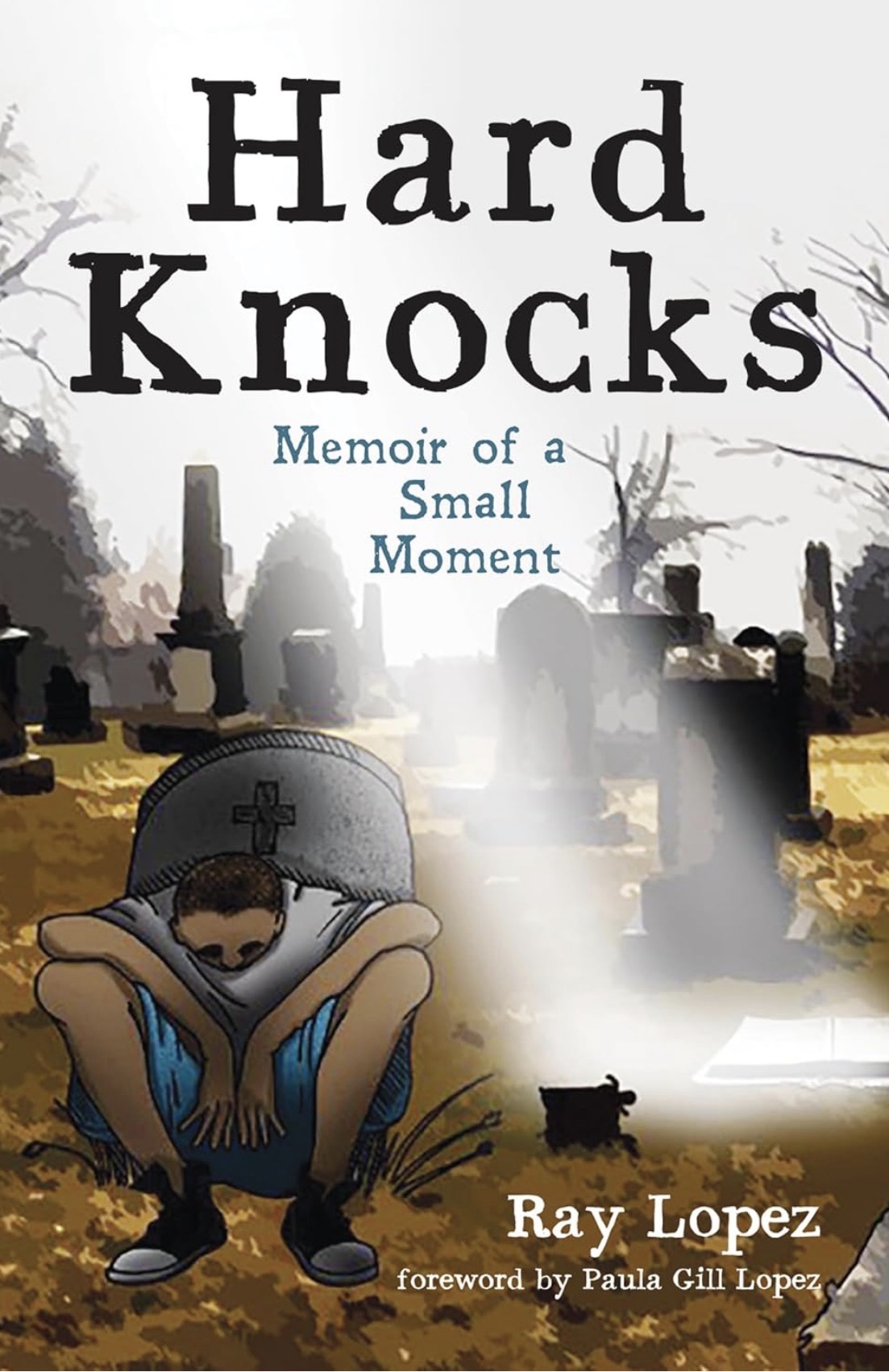
Hard Knocks
Memoir of a Small Moment
“For a small moment have I forsaken thee; but with great mercies will I gather thee. In a little wrath I hid my face from thee for a moment; but with everlasting kindness will I have mercy on thee, saith the LORD the Redeemer.”
—ISAIAH 54: 7, 8
“We proclaim to you what we have seen and heard, so that you also may have fellowship with us. And our fellowship is with the Father and with his son, Jesus Christ. We write this to make our joy complete.”
—1 JOHN 1: 3, 4
“Are you experienced? Have you ever been experienced? Well, I have.”
—JIMI HENDRIX
Chapter 11
THE GREAT SINK INCIDENT
In spite of my many distractions, I wanted to please Mr. S. by acing the midterm. In preparation for the test, I stopped partying for a couple of weeks and actually studied my trig problems. I took a break one night and went to see One Flew Over the Cuckoo’s Nest, starring Jack Nicholson as R.P. McMurphy and Louise Fletcher as Nurse Ratched. For the first time in my life, I felt inspired by a film, and Jack Nicholson became my favorite actor. On the day of the test, I came in with confidence, but my mind went completely blank when I stared at the problems on paper. Perhaps I put too much pressure on myself or was just a pathetic burnout. Regardless, as the bell sounded, I walked out enraged. Mr. S.’s classroom was on the second floor, and after the bell sounded, I walked down the hall toward the front of the school, kicking and punching lockers on the way. I entered the boys’ restroom near the stairwell and grabbed the middle sink, both hands locked on like a vice. I was alone. I noticed my rapid breathing, the tension throughout my body, and the screaming in my brain. “Shitttt!” Then a vision came; I pictured the Chief at the end of the movie. I watched in my mind as he wrapped his arms around the huge water cooler. My heart began beating faster as he ripped the cooler from its foundation, lifted it to his shoulder and hurled it through the caged window.
And as the Chief escaped and slowly jogged off into the woods on his way to Canada—to freedom—I knew what I needed to do. I began to pull at the sides of the sink, mustering all the strength I possessed. I heard the pipes begin to break and the sound of spraying water; my strength surged. I ripped the sink free and carried it to the window, left open wide enough for me to toss it out into the courtyard below. I was apparently oblivious to the school layout at the time, and didn’t know whether anyone had been placed in any danger by my inspired purge. Water gushed from the broken pipe and rushed across the floor into the hallway.
If I turned left to exit the bathroom, I could’ve easily run down the stairs and out the front door, undetected. Instead, I turned right and ran down the hall, past all the classrooms and all the teachers who emerged after hearing the commotion. I ran down the back stairwell, catching my breath, and casually walked into the cafeteria. Eighth period was free for both Mr. S. and me, and he usually lounged in the Dean’s Office. I’m sure he received a quick report on my crime because as I walked out of the cafeteria, munching on an ice cream sandwich, he came heading straight toward me. We stopped; he looked me straight in the eyes—like he always did—and asked, “You been doing something wrong, boy?” to which I found my head nodding in affirmation. They suspended me for three days, and I paid for two sinks because the sink I tore from the wall smashed the one to the right of it.
The Great Sink Incident cemented my legacy. Some thought if I could rip a sink from the wall, I could break a guy’s neck. I eventually became aware of the Great Sink Incident as experienced by others. Mrs. Calabro taught Spanish in a classroom directly below the boys’ room, and she liked to look out across the courtyard when teaching her class. Eyewitnesses reported that when the sink came crashing down a few feet from where she stood, she jumped, shrieked like a woman in a horror movie, and took quite some time to calm herself down. She dismissed her class early. On the opposite side of the courtyard, a couple of stoners—think Cheech and Chong, staring out the second floor window of their biology class, high as kites—saw the sink fall from the window to the courtyard, turned to each other and had the following exchange: “Dude, did you just see that sink fly out the window?” “Yeah man, that was so cool!”
For some reason, by the start of my senior year, they still hadn’t replaced the sinks. One day, I walked into the same bathroom to find a group of sophomores gathered. Four or five of the little dudes stood facing me, listening to their buddy giving an “eyewitness” account. He described the event in detail, the sound and the rushing water. Then he noticed that his friends’ attention focused on something behind him. I realized the kid’s instincts functioned well when he rhetorically asked, “He’s standing right behind me, isn’t he?” They simultaneously nodded in affirmation and slowly, silently walked past me and exited the bathroom like little ducks in a row. After The Great Sink Incident, my guidance counselor worked out a therapeutic program which allowed me to leave school any time I felt angry or anxious. And ten years later, when Paula and I were living in Southern California, she received a call from her younger brother, Michael, a student at Commack North. He asked if the sink incident really happened and became concerned about his sister’s safety upon hearing the truth.
The Great Sink Incident brought me a lot of attention. People looked at me expressing a new level of fear and curiosity. Teachers averted eye contact, except for Mr. S. Even Tony felt threatened. Friends and competitive rivals, I could beat Tony in a sprint, but he surpassed me in strength. He was tough and had beaten up a lot of guys. One day, we started roughhousing in the cafeteria and Tony shoved me toward the wall separating the cafeteria from the courtyard. It was lined with heavy glass windows, and kids often sat on the floor along the wall. Tony pushed me toward two girls sitting between two windows. In order to avoid crashing into them, I side-stepped them to the left, and my momentum carried my head through the window, smashing through the drone of casual conversations. Immediately afterward, someone got a plastic chair for me and I sat down, bleeding profusely from a large laceration on the top of my head. A crowd gathered around, pressing in, gawking in amazement and disgust. Being the center of their attention angered me. I saw a significant amount of blood pooled on the chair between my legs and slapped it, splattering blood upon the onlookers who recoiled and shrieked in terror. Coach D. showed up and walked by my side as they transported me to the nurse’s office, nervously joking about getting me a larger helmet.
The nurse bandaged my wound, and the Commack Volunteer Ambulance Corp showed up to take me to the hospital. Mom and our next-door neighbor, Jenny, were founding members of the Corps, and Jenny happened to be the driver that day. Mom was working a swing shift at the ER. I’m pretty sure Jenny launched the ambulance fully airborne as we drove over the small, steep hill crossing the railroad tracks. The ER visit turned into an episode of The Twilight Zone with Rod Sterling. The nurse unwrapped my bandage and started to laugh, which confused me and caused some concern. Were my brains hanging out, causing her to have a nervous breakdown? The nightmare got worse when she gathered the other nurses on duty to take a look, and they also began to laugh. Was this some type of mass hysteria? Mom finally arrived and allayed my fears by explaining that the nurse at the school had used a tampon to dress my wound, and her coworkers just found this to be the funniest thing. I didn’t think it was funny.
My mom was tough. I guess with me as a son, she had to be. One enchanted evening we were taking bong hits in my bedroom in the basement and blowing the smoke out the window. I know big Brian S. was there. We were both big-time partiers and our endurance was infamous. Depending on your body chemistry, experience and ambition, one could drink a tremendous amount of alcohol, do a ton of drugs, and remain conscious and functional in your own mind. Now that doesn’t include blackouts, of which I had many I don’t care to remember. Getting back to the bong party in my room, Johnny R. brought some Rum & Coke and we were mixing drinks in the bathroom. Why we weren’t doing that in my bedroom I don’t know. Just stupid. Before going to work for her graveyard shift, Mom came down to remind me that my friends and I had to leave. She stopped in the bathroom first and discovered our toilet & sink bar. Of course I was playing records on my turntable, probably Wish You Were Here, Pink Floyd’s new album, so we couldn’t hear but the last three knocks on the wooden door that caused the record to skip. I opened the door and went out to talk to Mom. I don’t remember what she said. But I do remember part of what she said to my friends. After I reentered the room, everyone quietly asked, almost whispered, “What did she say? What did she say?” Mom burst into the room and answered “I’ll tell you what she said, right from The Horse’s Mouth!” I don’t remember what she said after that and neither did my friends. However, they could never forget the evil eye cast upon them. I was used to it but it left a lasting impression on the stoners.
We also played pool in the basement, where I honed my skills in 8-Ball. One Saturday afternoon, we were playing for money. A primary rule of my residency as the beast in the basement: I couldn’t leave my shit upstairs, especially my shoes. As I lined up the winning shot, the basement door opened, and Mom threw my boots down the stairs. They hit the end of the cue stick, causing me to scratch on the shot and lose the game. My friends started laughing and I got pissed off, picked up the boots and launched them up the stairs, smashing against the door. The door opened and Mom slowly descended the steps. I leaned back against the end of the pool table, the cue stick in my hands, trying to be cool in front of my buddies. She swiftly grabbed the stick and smacked me over the head several times, rendering me stunned and seeing stars; she then placed the stick back in my hands, which helped me maintain my balance as she ascended the stairs. My friends followed her up silently and exited through the back door. Thereafter, any time I invited people to come over to party or shoot pool, they always asked, “Is your mom going to be home?”
“Then Samson reached toward the two central pillars on which the temple stood. Bracing himself against them, his right hand on the one and his left hand on the other . . . he pushed with all his might, and down came the temple . . .”
Judges 16:29, 30
Summary
My first memoir is the story of my dynamic journey through life from birth until the day after my twenty-first birthday. It takes place during the 1960s and 1970s on Long Island in New York. From my Latino background, I take you through my cultural confusion, as my parents tried to assimilate within a predominantly white community, and my confrontation with overt racism at school. It details the abusive environment I faced in Catholic school, my growing anger, and my fall into childhood alcoholism and delinquency. The Vietnam War, counterculture, and science provide a constant background for my growing awareness, choices, decisions, and delusions about the world and my own life. My alcoholism merges with drug addiction and I find value and identity within a gang. The momentum of my life, balancing precariously between rebellious destruction and a search for artistic beauty and truth, takes you through the criminal justice and mental health systems, where I awaken to the truth of Christ in my life.


Foreword by Paula
I met Ray Lopez when I was 16. He was 15. He was tall, dark, and handsome. He wore overalls and black-rimmed glasses. His shoulders were broad and his reputation was bad. I was smitten. I experienced Ray’s reputation from a distance, while I experienced his heart up close. He was smart, charming, and funny. When he went down to Florida with his family to visit his grandparents one Christmas, he brought me back a tee shirt with a big red apple; it read, “I like you.” Our daughter occasionally wears it today.
There was something about the class of 1977 at Commack HS North. The “hooligans” seemed to be the devil’s spawn. They were puppets and the devil pulled the strings. Looking back, it was like they were cursed. So many in Ray’s class ended up in prison or did not survive into their early twenties. When the class of ’77 graduated, a twelve-foot chain link fence was erected around the perimeter of the school property. I always thought it wasn’t so much to keep students in, but rather to keep the 1977 graduates out.
Just as God uses all things for good, the devil uses all things for evil. He stokes the rage of racism with alcohol and drugs and overcomes unconditional love with indifference and pride. Though I didn’t know it at the time, there was a supernatural war going on during Ray’s formative years—the prize was his soul. This is the account of that bloody battle. This memoir describes a young boy who seethed with fury, who descended into the depths of self-destructive self-loathing as a teenager, who was tormented and nourished by an illicit drug phase, followed by a Lithium/Thorazine craze, and finally a Jimi Hendrix purple haze. The Ray in this memoir is unrecognizable to me. Even though I “grew up” with him and have heard all the stories many times, the man into which he has evolved is such a powerful devotee of Christ that it’s difficult to imagine him otherwise. His email address begins “raylohalo,” a nickname he was christened with by a colleague in the U.S. Probation Office years ago. I need not say more. The only explanation for the transformation is Jesus. I left college after two years and moved back to Commack an atheist. Those who believed in God, who relied upon God, were weak. I understood God to be a crutch for people who were unable to do for themselves. Ray’s conversion paved the way for my own rebirth.
Today, I am a woman of strong faith. “The only thing that matters is faith expressing itself as love”—Galatians 5:6. My relationship with Jesus is my ALL. My first step on the road from atheist to Jesus freak began in 1980 with the realization that if Ray wasn’t dead, there must be a God. I pray that by reading this book your faith is similarly awakened. —Paula Gill Lopez
Reviews
“Ray Lopez’s Hard Knocks is a stunning memoir of the seemingly inevitable destruction of a confused young man. . . . On the surface he appears to be just another casualty of addiction, but dig deeper and you’ll find another narrative, one of faith and redemption.“
–James Brown, author of Apology to the Young Addict and The Los Angeles Diaries
“Lopez writes in a sophisticated but vivid, plain style that calls attention to what’s going on in the world in which the author confronts hard knocks and gives some too. . . . Hard Knocks is a book of many pleasures. It is an affirmation of one’s life and one’s heritage.“
–Donald W. Markos, author of Ideas in Things: The Poems of William Carlos Williams
“Hard Knocks is a relevant story for today. Seeds of hate were sown in Ray’s young heart as he tried to navigate through a climate of racism and hate. Hard Knocks fully reveals the inner rage that took Ray to the precipice of self-destruction–prison and hospitalization. How does a man filled with rage, hate, and revenge become a man filled with love, especially for those caught in the same struggle?“
–Vinny Carbone, teacher, Fairfield, Connecticut
